
- sales@iiservz.com
- Plot 6 Naina Components, Sector 140, Pin Code : 201305 Noida, India




How to Choose the Right Background Verification Partner in India?
The hiring decisions play vital roles once taken by any organization. Various interviews, tests, and resumes help recruiters to analyze candidates for their recruitment process, but they do not have sufficient independent material to confirm all the claims in the process of recruiting. This is why background checks are gaining significant importance with each passing day.
However, choosing a verification provider can be challenging. Businesses have different hiring volumes, workforce structures, locations, and risk requirements. As a result, the right provider is not necessarily the one offering the largest number of checks or the lowest price.
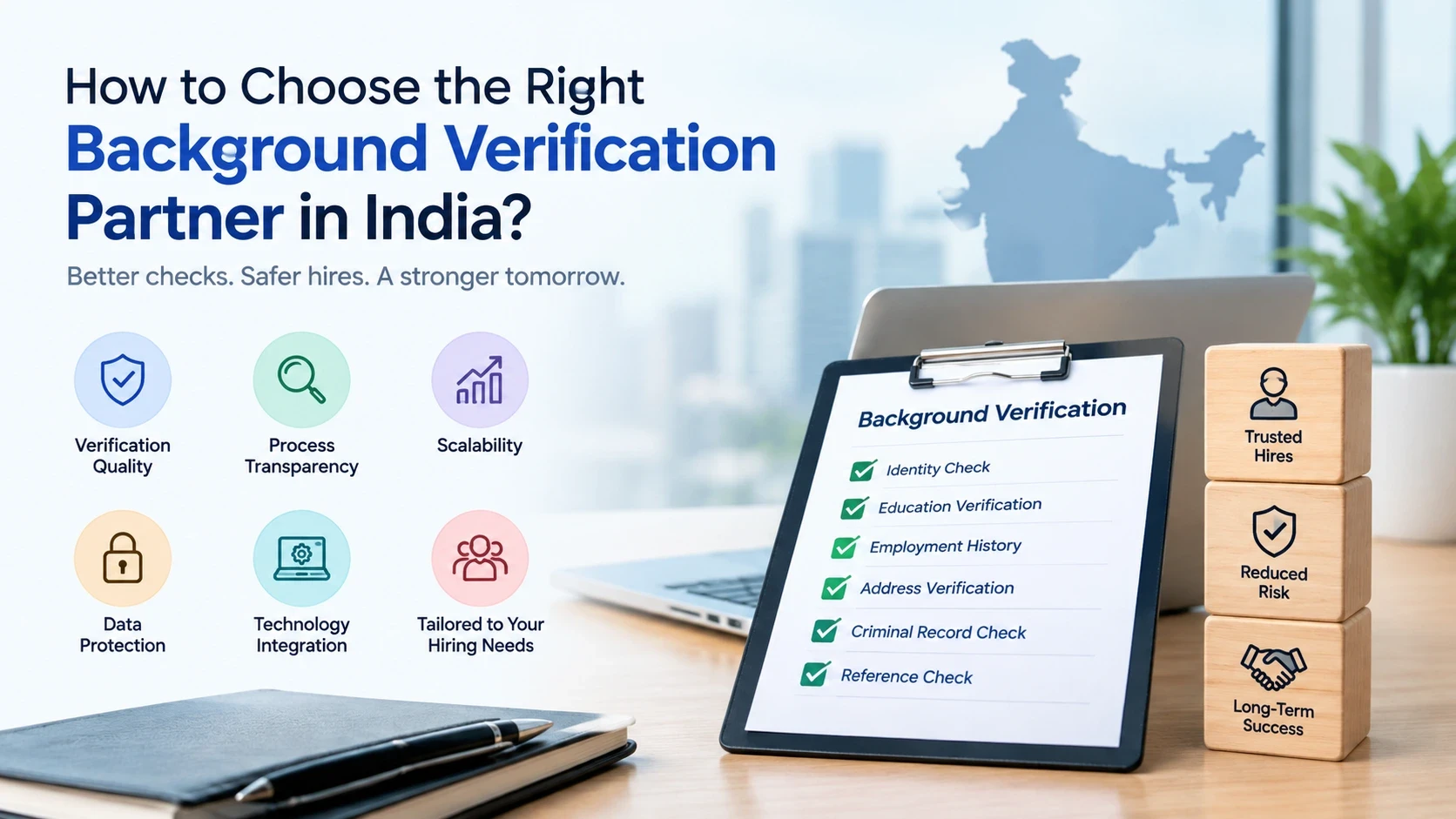
Organizations searching for the top background verification companies in India should instead evaluate providers based on factors such as verification quality, process transparency, scalability, data protection, technology integration, and the ability to support their specific recruitment requirements.
Why Businesses Need a Structured Verification Partner
Various stakeholders, documents, sources, and follow-ups may be involved in the process of verification. When activities related to verification are being carried out manually, collecting information may take plenty of time of the HR team.
A verification partner can help in making these operations centralized by establishing a clear and defined process of verification.
A structured approach can also bring in consistency since all recruiters will use the same verification approach without being able to adapt a way of checking candidates in a different manner.
When Should Organizations Conduct Background Verification?
The timing of verification is influenced by the ongoing policy and the specifics of each position.
Some businesses start the verification process when a candidate receives a conditional offer, while others may opt for some checks at an earlier stage of recruitment. The appropriate timing is determined by factors such as the position, conditions under which the company operates, the experience of the candidate, and certain other requirements.
It is essential that the verification procedure is clearly stated to candidates by the Organization and that prior to starting the checks, all necessary authorizations are received.
The availability of a certain timeline helps human resources departments manage expectations better. Candidates should be aware of what information is necessary, how the verification process works, and what can trigger some additional checks and verifications.
Different Hiring Models Require Different Approaches
Nowadays, a modern organization does not use the same hiring method solely. There is a usage of paid staff members and external individuals such as consultants, contractors, freelancers, and temporary workers.
Different categories of employees also have different needs for verification.
For regular workforces, companies adopt the common screening methods with minimum variations depending on job levels and job description. On the other hand, for contract and temporary workers, the onboarding process is less time-consuming.
Moreover, when hiring senior positions, the organizations need extra effort in carrying out due diligence to ensure that the candidates will not be able to harm the company.
Overall, different screening methods should be applied according to the necessity for verification for every type of employee.
What Can Happen Without a Defined Verification Process?
An inadequate verification system can lead to problems beyond the hiring decision itself.
The lack of standardized procedures can negatively affect record-keeping, onboarding, tracking of applications, and results of specific verifications.
Another concern is the management of discrepancies since differences between the information provided by candidates and verified data do not clarify the reason for those differences.
Also, it is not always easy for HR teams to determine when a discrepancy needs to be investigated and who needs to conduct this investigation without an effective escalation process.
The use of the well-organized provider can streamline the processes of performing verifications.
What Should You Look for in Background Verification Companies?
Businesses comparing the top background verification companies in India should assess the provider across several practical parameters.
Process Transparency
Organizations should be able to understand how a verification request progresses from initiation to completion. Clear status tracking can help HR teams identify pending cases and understand where delays may be occurring.
Source Reliability
The quality of a verification result depends significantly on the sources and methods used. Businesses should understand how information is obtained and how results are validated.
Discrepancy Handling
Not every discrepancy indicates intentional misrepresentation. A good verification process should have mechanisms for reviewing differences and obtaining clarification where appropriate.
Reporting and Documentation
Reports should present relevant findings in a format that authorized HR or compliance teams can understand and use. Proper documentation can also make it easier for organizations to maintain internal records.
Scalability
The provider should be able to handle changes in hiring volume. A company recruiting 50 employees a month may eventually need to process hundreds or thousands of cases.
Scalability therefore matters not only in terms of processing capacity but also in maintaining consistency as volumes increase.
Integration Capabilities
Organizations already using HRMS, applicant tracking systems, or recruitment platforms may benefit from verification solutions that integrate with their existing systems.
Integration can reduce repetitive data entry and make verification a more connected part of the recruitment workflow.
Candidate Experience Should Not Be Ignored
Although it is often considered from an employer's perspective, the candidate's experience is equally significant.
The candidate can likely feel frustrated from receiving a number of requests for information, confused instructions, and updates from different people. A verification process that is lacking in organization will result in unnecessary waiting and lack of communication.
A well-organized process will clearly outline what information is required, what actions the candidates must take, and how they should respond in case they need clarification.
Digital workflows may simplify this process by offering structured communication and eliminating unnecessary “back-and-forth" communications.
Managing Verification Across Multiple Locations
Businesses based in India are likely to recruit applicants from various cities and states which in turn would mean that their verification would entail diverse sources and operational requirements.
This complexity increases for organizations involved in international recruitment.
When considering leading background verification service companies in India, organizations with decentralized workforce recruitment should consider whether the service provider has the capacity and practice necessary to conduct verifications in the specific geographical location.
The process of verification could be crucial for organizations planning to expand their business in to new areas.
How to Measure the Performance of a Verification Partner
Selecting a provider should not be the end of the evaluation process. Organizations can establish internal measures to assess whether the verification program is delivering the expected operational value.
Relevant indicators may include:
- Average verification turnaround time
- Percentage of cases completed within the defined timeline
- Number of cases requiring additional clarification
- Pending verification volume
- Frequency of incomplete submissions
- Candidate response time
- Reporting and escalation efficiency
Tracking these indicators can help HR teams identify bottlenecks and determine whether changes are required in the verification workflow.
IISERVZ for Background Verification Requirements
IISERVZ provides background verification and risk mitigation solutions for organizations with different workforce and recruitment requirements. Its services support areas such as employment, education, identity, address, and other verification needs, while technology-enabled workflows help organizations manage verification activities more efficiently.
IISERVZ states that it has more than 17 years of industry experience and serves 300+ enterprise clients, with verification capabilities across 100+ countries. Its solutions also include API-based integration and automation capabilities, allowing businesses to connect verification activities with existing HR and recruitment systems.
This combination of verification services and technology can support organizations looking to establish a more structured screening framework as their recruitment requirements evolve.
Making an Informed Choice
There is no universal definition of the "right" verification provider for every organization. A company hiring a small number of employees locally may have very different requirements from a large enterprise recruiting across multiple locations.
Businesses should therefore evaluate providers based on their own workforce, hiring volume, role requirements, geographic reach, technology environment, and internal processes.
When comparing the top background verification companies in India, organizations can look beyond basic pricing and the number of checks offered. Process transparency, source reliability, discrepancy handling, scalability, data protection, integration capabilities, reporting, and candidate experience can all contribute to a more effective verification program.
A well-designed partnership can help HR teams make verification a consistent part of recruitment rather than an isolated administrative task. As workforce models continue to evolve, having a structured and adaptable verification process can help organizations manage hiring with greater consistency and confidence.