
- sales@iiservz.com
- Plot 6 Naina Components, Sector 140, Pin Code : 201305 Noida, India




Fast Hiring vs. Safe Hiring: Why Employee Verification Cannot Be Overlooked
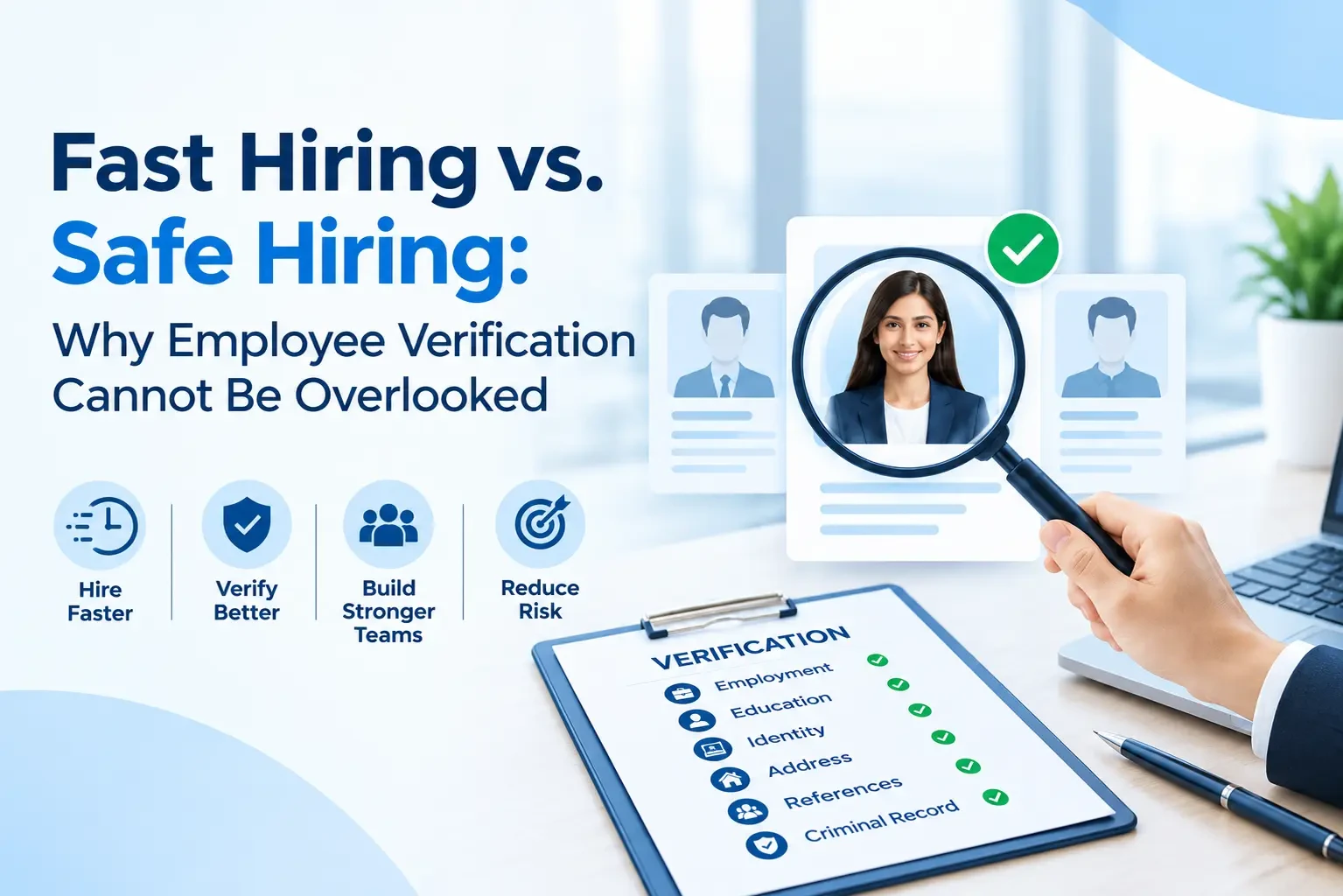
Finding the right candidate to fill an open position is not only about hiring the required person. Companies must find a person who has the right skills and qualifications. However, some organizations may make mistakes when taking hiring decisions due to the pressure that exists in the business environment.
While the rapidity of the recruitment process can help to save time, the organization can overlook important steps in the employment verification process which can lead to serious consequences in the future.
Why Businesses Prioritize Fast Hiring
Delays in recruitment can impact productivity team efficiency, and business processes. When a position is unfilled, employees may have to take on more work.
Businesses often seek to fill jobs quickly for a variety of reasons:
- Immediate staffing needs: In order to complete tasks in a timely manner, teams require staff.
- Large volumes of hiring: HR departments may be dealing with many candidates at once.
- Competition for talent: Delaying decisions results in strong candidates getting hired elsewhere.
- Business development: New ventures require staff to be brought on board quickly.
- Consistency in operations: Being without staff compromises service delivery to clients.
What Can Go Wrong When Verification Is Skipped?
Resumes and interviews are helpful in providing information. Nevertheless, they cannot externally verify every detail provided by the job candidate. Failing to do due diligence can lead to multiple difficulties for the employer.
- Wrong Employment Data
Candidates could end up giving wrong employment dates, job positions, or descriptions of their previous jobs. With employment verification, it may be possible to check the information with the right people and expose discrepancies that need additional explanation.
- Unverified Education Information
Certain jobs have specific requirements in the form of degrees, certifications, and other documents. Without proper verification, employers might be the victims of positions that were not validated.
- Misidentification
It is important to have the correct identity in recruitment and onboarding. Identity verification process allows employers to make sure that the candidates provide the right information.
- Different Information from Various Documents
The information that can be found in the resume, application form, and other papers might not be the same. Although such differences do not necessarily mean that fraud has occurred, they can still require further analysis before hiring decision is taken.
Fast Hiring vs. Safe Hiring: Finding the Right Balance
Fast hiring and safe hiring do not have to be opposing goals. Businesses can improve recruitment efficiency by making verification a planned part of the hiring process.
The key is to establish clear procedures and use appropriate technology.
| Fast hiring approach | Safer hiring approach |
|---|---|
| Focuses only on filling vacancies quickly | Balances speed with candidate verification |
| Relies heavily on resumes and interviews | Validates relevant information independently |
| Handles checks through scattered emails | Uses structured verification workflows |
| Resolves discrepancies at the last minute | Identifies and reviews discrepancies early |
| May create inconsistent screening practices | Applies defined, role-appropriate checks |
A well-organized process helps HR teams make timely decisions while maintaining appropriate verification standards.
What Should Employee Background Verification Include?
The checks required will depend on the job role, industry, and organizational policies. Not every candidate needs the same screening package.
Common verification checks include:
- Employment verification: Confirms relevant previous employment details.
- Education verification: Validates academic qualifications and certifications.
- Identity verification: Checks relevant identity information.
- Address verification: Helps validate residential details where required.
- Reference checks: Provides additional context about previous professional experience.
- Criminal record checks: Where legally permitted and relevant to the role, these may form part of the screening process.
Employers should select checks based on legitimate business needs. They should also follow applicable laws and obtain the required authorization.
How Technology Can Make Verification Faster
Manual verification can involve repeated emails, phone calls, document collection, and follow-ups. These activities can slow down recruitment, particularly when HR teams handle multiple vacancies.
Technology can simplify many of these tasks.
Automated Workflows
Digital workflows help HR teams initiate checks, monitor progress, and track pending cases. This reduces repetitive administrative work.
API Integrations
Integration with HRMS and applicant tracking systems can connect verification activities with existing recruitment processes. It can also reduce duplicate data entry.
Centralized Reporting
A centralized dashboard helps HR teams view verification status and identify cases requiring attention.
Faster Discrepancy Management
Structured reporting makes it easier to identify differences between submitted information and verified records. HR teams can then request clarification where necessary.
Technology can improve efficiency. However, it should support human review rather than automatically determine whether a candidate should be hired.
How to Choose an Employee Background Verification Company
Outsourcing verification can help businesses manage screening requirements more consistently. However, choosing the right provider requires careful evaluation.
An employee background verification company should offer more than a list of verification checks.
Consider the following factors before making a decision:
- Verification coverage: Check whether the provider offers the checks relevant to your workforce.
- Turnaround time: Understand expected timelines and how delays are communicated.
- Technology capabilities: Look for digital workflows, reporting tools, and suitable integrations.
- Data security: Evaluate how candidate information is collected, processed, stored, and protected.
- Geographic coverage: Consider whether the provider can support hiring across your operating locations.
- Scalability: Ensure the provider can manage changes in recruitment volume.
- Reporting quality: Check whether results are clear, documented, and easy for authorized teams to review.
The right provider should fit your recruitment process and help maintain a balance between operational efficiency and verification quality.
How IISERVZ Supports Employee Verification
IISERVZ provides background verification and risk mitigation solutions for organizations across different industries. Its services include employment, education, identity, address, and other verification checks.
The company also offers technology-enabled capabilities, including API-based integrations and automation. These can help businesses connect verification activities with their existing HR and recruitment workflows.
IISERVZ states that it has more than 17 years of industry experience, serves over 300 enterprise clients, and supports verification requirements across more than 100 countries.
For organizations managing regular or high-volume recruitment, a structured verification process can help reduce manual coordination and improve visibility into pending checks.
Best Practices for Balancing Speed and Verification
Businesses can make recruitment more efficient without overlooking important checks.
Here are some practical steps HR teams can follow:
- Define screening requirements early. Decide which checks are appropriate for each role.
- Start verification at the right stage. Build the process into recruitment planning rather than treating it as an afterthought.
- Communicate requirements clearly. Inform candidates about the documents and authorizations needed.
- Use digital tools where appropriate. Reduce repetitive tasks through automation and integration.
- Review discrepancies objectively. Give candidates an appropriate opportunity to clarify inconsistencies.
- Protect sensitive information. Restrict access to authorized personnel and follow applicable data protection requirements.
- Monitor turnaround times. Review delays and improve inefficient steps in the workflow.
These measures can help HR teams create a consistent process without adding unnecessary complexity.
Conclusion
Fast hiring helps businesses respond to immediate staffing needs. Safe hiring helps ensure that recruitment decisions are supported by reliable information.
Organizations do not need to choose one over the other. With clear procedures, appropriate technology, and role-specific checks, businesses can make recruitment both efficient and responsible.
Partnering with an experienced employee background verification company such as IISERVZ can help organizations manage verification requirements through structured processes and technology-enabled workflows.
Ultimately, the goal is not simply to hire faster. It is to make timely hiring decisions with greater confidence in the information used to support them.
FAQs
- What are the risks of skipping employee background verification?
Skipping verification can expose businesses to credential fraud, inaccurate employment histories, and avoidable hiring risks. IISERVZ helps employers validate candidate information. - Can background verification identify fake experience certificates?
Yes, employment verification can help identify discrepancies in a candidate’s work history. IISERVZ supports businesses in verifying employment credentials. - Is background verification necessary for remote employees?
Yes, remote hiring requires the same level of due diligence as office-based hiring. IISERVZ helps businesses verify candidate details across locations. - How does employee verification support better hiring decisions?
It gives employers greater confidence in candidate credentials before onboarding. IISERVZ’s background verification services support informed hiring decisions. - Can businesses verify candidates across different countries?
Yes, international screening can help employers verify credentials across borders. IISERVZ offers background verification capabilities across multiple countries. - What should HR teams do if verification reveals discrepancies?
HR teams should review the findings, seek clarification from the candidate, and follow company policy before making a decision. - Why outsource employee background verification?
Outsourcing helps HR teams manage screening more efficiently while focusing on recruitment. IISERVZ provides verification support to businesses with diverse hiring needs.