
- sales@iiservz.com
- Plot 6 Naina Components, Sector 140, Pin Code : 201305 Noida, India




How AI and Deepfakes Are Changing Employee Background Verification
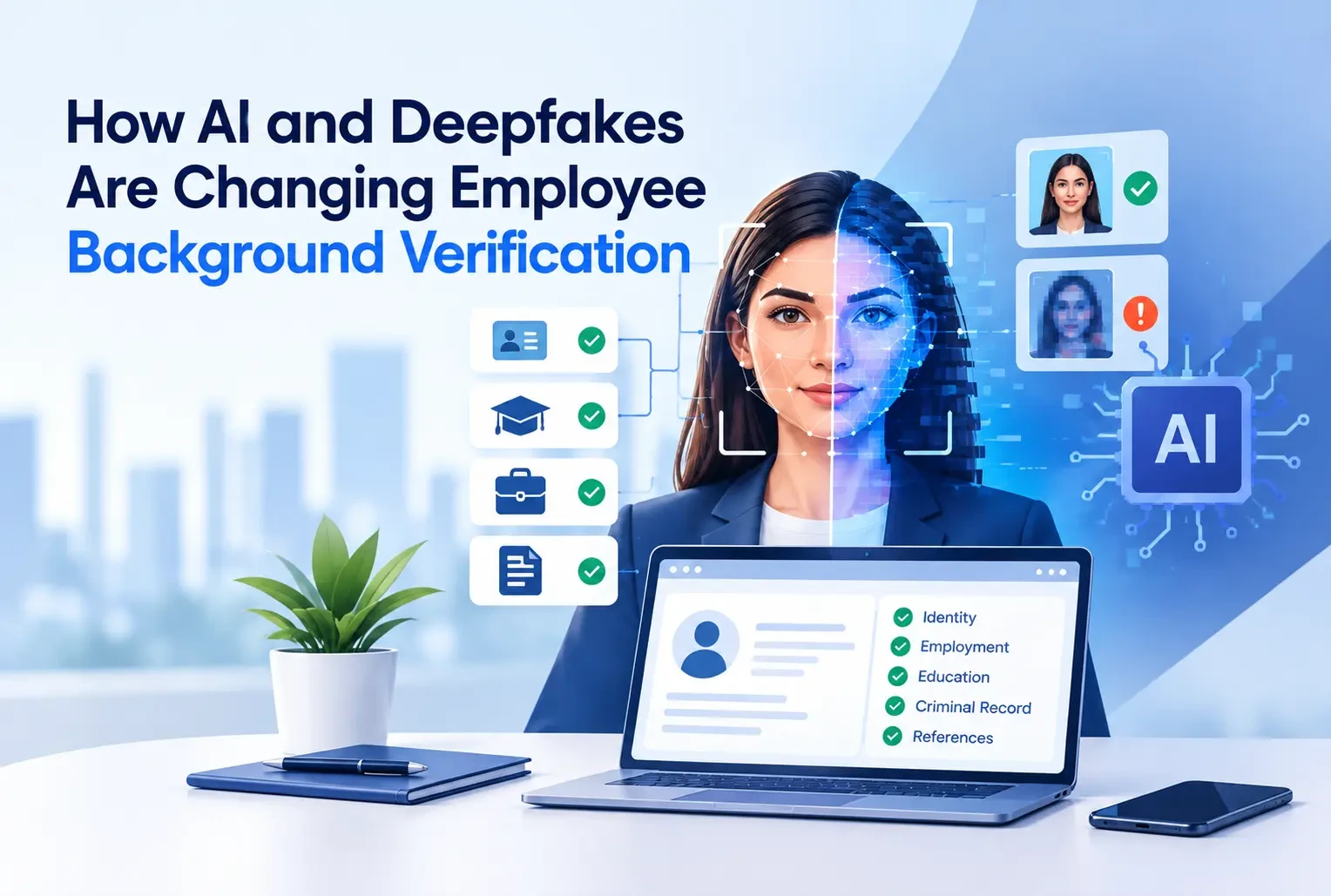
Artificial intelligence has revolutionized recruitment processes for both candidates and employers alike. Job seekers use AI to create impressive resumes, enhance their applications, prepare for interviews as well produce other documents they require for their job search. At the other end of the hiring process, employers are using AI and automation technologies to quickly go through huge volumes of applications in order to accelerate the hiring process. However, this gives rise to the new challenge – how can businesses be sure that the person they are hiring is competent the way they say they are?
This is exactly where modern background verification companies play an important role. Background verification is not confined to verifying educational experiences or employment records after a candidate has been chosen anymore. In the era of digitalization and remote work, companies are realizing that background verification is an integral part of building candidates’ trust and identity.
Why AI Is Changing the Hiring Verification Process
The applications produced through AI technology are gaining traction. According to a survey, around 73% of due companies have had some encounters with AI-based resumes, CVs, or assessments, with one out of three of them pointing out that AI-produced documents are faced on a regular basis. Additionally, it has become clear that more than half of entrepreneurs (62%) believe that AI has ultimately undermined the effectiveness of traditional job application analyzing techniques.
While using AI-powered systems for making documents grammatically correct and more well-structured is a problem in itself, the main issue comes from the fact that technology can be used to change personal data about a person.
Thus, employers should take caution since a properly written CV does not represent evidence of a person being competent at all.
What Is AI-Driven Hiring Fraud?
Fraud in recruitment driven by AI refers to the utilization of artificial intelligence or similar digital technologies to falsify the identity, competency, experience and involvement of a job candidate in the recruitment process.
Examples of this type of fraud can involve fake resumes, fake documents, a fabricated identity, impersonation in online interviews, or the usage of AI-generating content while making false claims. Deepfake technology makes the process of confirming identity more difficult because any picture, video or audio created through computer technology looks credible.
The increased complexity of this form of fraud means that employers are required to implement checks that go beyond traditional ways.
Why Traditional Resume Screening Is No Longer Enough
Primarily, a resume is a self-reported document. It provides employers with a picture of the candidate's career, but does not independently verify the accuracy of any information provided. For example, someone may say that they have five years of experience in a previous firm. Though a recruiter could look at the resume, conduct interviews and assess technical skills, the process of employment verification can independently confirm the organization, employment duration, designation, and so on, subject to proper verification process and authorization.
This same rule applies to education qualifications as well. A candidate could claim to have a degree from a respectable institution, but education verification is a different method for checking the veracity of the qualification.
The significance of this distinction is growing as AI technological advancement helps create convincing materials much easier.
What Should Modern Background Verification Include?
There is no single verification package that is appropriate for every organization. The checks required can depend on the role, industry, location and level of access associated with the position.
A comprehensive program may include:
- Identity verification to establish that the candidate is the person represented during recruitment.
- Employment verification to validate relevant professional history.
- Education verification to confirm academic credentials.
- Address verification to validate residential information where required.
- Professional reference checks to obtain relevant information from previous professional associations.
- Criminal record checks, where legally permitted and relevant to the role.
- Document verification to identify inconsistencies or potentially manipulated information.
The objective should be proportionate verification rather than collecting every possible piece of information. Employers should determine which checks are relevant to legitimate hiring and risk-management requirements.
How Background Verification Companies Are Adapting to AI Risks
The evolution of background verification services is driven by the rise of new fraud schemes. The use of technology to streamline the verification processes is becoming mainstream, allowing it to be faster, more reliable and more accurate in identifying inconsistencies.
Today's platforms can carry out digital processing, incorporate APIs, automate workflows, ensure identity verification and facilitate centralized case management. These features simplify large-scale hiring processes by technology enabling HR teams to avoid complete reliance on manual work.
Automation, however, should not be mistakenly interpreted as an entitlement to consider all verifications to be automatic hiring decisions. Complicated discrepancies may require a human review, supporting evidence or additional verification of the candidate.
Therefore, the best way to go about it is to balance technology implementation and expertise in verification with clear guidelines in reviewing procedures.
Identity Verification Is Becoming More Important
One of the most significant shifts in contemporary hiring is the increasing necessity of ensuring that the identity of the applicant corresponds to the person being interviewed. This issue is particularly crucial in the context of remote recruitment. In the context of an interview being conducted virtually, it becomes increasingly difficult for employers to conduct face-to-face verification. HireRight's worldwide benchmark report from 2026 points to issues of identity fraud and AI-related hiring risks as a matter of concern for HR professionals involved in employment screening. The survey of 1,900 experts in HR, risk, and talent acquisition found that the precision and reliability of screening results were important factors in the process of hiring screening service providers.
How HR Teams Can Build a Stronger Verification Process
Organizations do not necessarily need to completely redesign their recruitment systems. Instead, they can strengthen specific stages of the existing hiring workflow.
First, identify which roles require verification and determine the checks appropriate to each role. Second, establish a consistent process for collecting candidate authorization and relevant information. Third, use reliable verification sources and maintain clear records of completed checks.
Technology can then be used to automate repetitive activities, track pending cases and integrate verification with recruitment or HR systems.
Organizations should also periodically review their verification process as hiring models and fraud techniques evolve. A process that was sufficient for predominantly office-based recruitment may require adjustments when an organization hires remotely, internationally or at high volume.
IISERVZ and Technology-Enabled Background Verification
IISERVZ provides background verification and risk mitigation solutions for organizations looking to establish structured and technology-enabled verification processes. Its services cover areas such as employment, education, identity and address verification, along with other screening requirements. IISERVZ also offers technology-driven capabilities, including API-based integrations and automation, designed to connect verification activities with existing HR and recruitment workflows. The company states that it has more than 17 years of industry experience, serves 300+ enterprise clients and supports verification requirements across 100+ countries.
What Should Businesses Look for in Background Verification Companies?
When comparing background verification companies, organizations should look beyond basic pricing and turnaround time. The provider's verification coverage, accuracy, technology capabilities, data security practices, geographic reach and reporting processes should all be considered.
Integration is another important factor for organizations conducting high-volume recruitment. API capabilities and automated workflows can reduce manual intervention and make it easier for HR teams to monitor verification status.
For organizations hiring across different countries, international coverage and knowledge of local verification processes may also be relevant. Most importantly, the provider should be able to support a verification framework that is appropriate to the organization's industry, workforce and legitimate screening requirements.
The Future of Background Verification
AI may not make verification less necessary, but it is changing what organizations must verify and in what time frames.
As resumes, documents and even parts of recruitment interactions become easier to manipulate digitally, the significance of independently verifiable information grows. Employers must weigh speed and candidate experience against the need for identity, credential and employment checks.
Thus, the future of employment screening will probably combine technology, independent verification, human input and well-defined processes. Organizations treating background verification as a key part of responsible hiring will be ahead of others, building their trust and adjusting to new threats posed by AI-enabled hiring.